
Fairytale palace chronicles – “Schloss Herrenchiemsee” (1995)

Dear readers, a few months ago, I came across a documentary by a German TV news network, DW, about the legendary Neuschwanstein Castle and the visionary spirit behind it, King Ludwig II of Bavaria. This program stirred something in me, particularly it brought back some of the vivid memories of my trip to Munich in April 2017; I still remember clearly that because of the story of this fairytale king, I have made a promise to myself that it is compulsory to visit all three of his great castles: Neuschwanstein, Linderhof, and Herrenchiemsee, during this trip.
Among the three, Neuschwanstein is undoubtedly the most famous, perhaps because its iconic silhouette later inspired the dreamlike image of Disney’s castle. Yet, my own personal favorite somehow has always been Herrenchiemsee; it is the least discussed of the three, at least among the people I know, but to me, it has a quiet magnetism that is so fascinating. There is something about its grandeur, its unfinished state, and its atmosphere of longing that has always held my imagination.


Since I got back after the trip, a certain unexplainable feeling about Herrenchiemsee keeps coming back in my head from time to time, that fascination eventually led me on a search for a book devoted to this extraordinary palace. While I did find a broader publication covering all three of King Ludwig II’s castles, I longed for something more focused on Herrenchiemsee itself. After a great deal of searching, I finally found one! A vintage book titled “Schloss Herrenchiemsee” written by the German art historian and author, Alexander Rauch. Despite it is written only in German, but that made the discovery feel more precious! Especially when I realized that there’s no single English book that is dedicated to this Bavaria palace (up until now), therefore, I bought it without hesitation, almost as if it had been waiting for me all along.


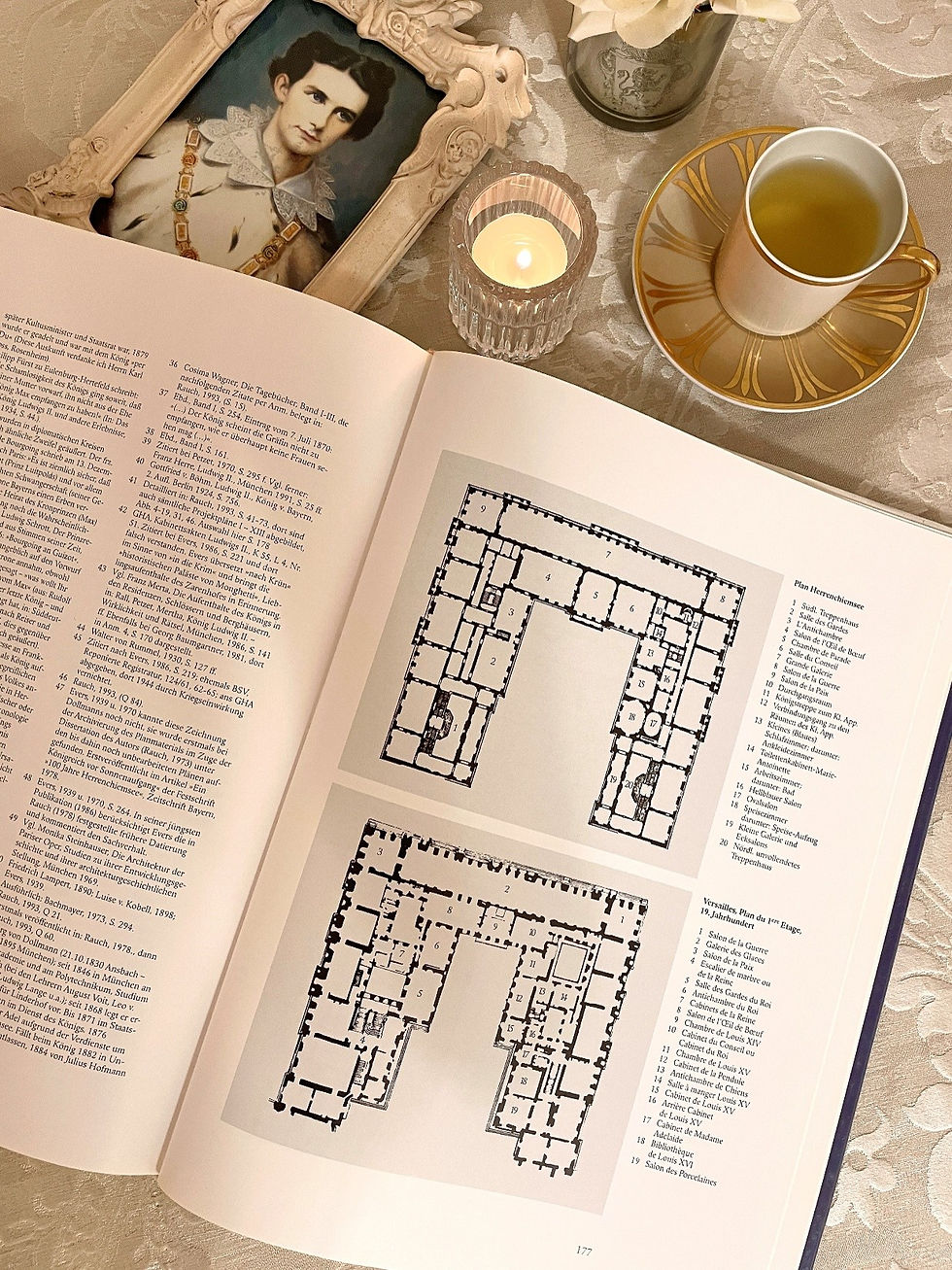
Published by Koehler & Amelang in 1995, this rare and beautifully made volume offers a visual journey through the palace grounds, the formal gardens, the extraordinary exterior, and the richly decorated and furnished interiors. This book takes the reader through the grand staircase, the State Bedchamber, the Council Chamber, and, of course, the magnificent Hall of Mirrors, page by page, it reveals not just architectural splendor and the construction work, but the extraordinary care and imagination behind the palace, a place conceived with such conviction that it still feels alive with its creator’s spirit.
As a brief history, Herrenchiemsee began construction in 1878 under the personal supervision of King Ludwig II. He entrusted the design to his court architect, Georg von Dollmann, with artistic contributions from Christian Jank and Franz von Seitz. The palace was conceived as an homage to the French Sun King, Louis XIV, and the Palace of Versailles, a royal statement of admiration and aspiration. In architectural terms, Herrenchiemsee is a striking expression of Neo-Baroque grandeur, enriched with classical symmetry and ceremonial order. It draws heavily from the language of French palace architecture, yet it also carries a distinctly Bavarian interpretation of magnificence — more intimate in some rooms, but no less ambitious in scale or refinement.

(My visit in Apr 2017)

(My visit in Apr 2017)
And yet, what makes Herrenchiemsee so moving is not only its opulence, but also its incompletion. The palace bears the silhouette of Versailles in its French Baroque and classical exterior, and within it one finds the same spirit of imperial splendor expressed through glittering chandeliers, gilded details, mirror-lined rooms, ornate wall panels, portrait of the Sun King, sculpted decoration, and richly upholstered furnishings. Every salon feels carefully composed, as though each detail was intended to complete a larger vision of cultivated power and refined living. Its Hall of Mirrors, stretching 98 metres, is even longer than the one at Versailles! Still, for all its brilliance, the palace was never fully realized. In fact, King Ludwig II spent only a brief period there in 1885, and after his unfortunate and mysterious passing in 1886, the construction of Herrenchiemsee came to a halt. The palace was opened to the public only a few weeks after the king’s passing, and in 1907 the unfinished north wing was demolished. What remains now is what we see today, it is undoubtedly breathtaking — not only as a monument, but as a fragment of a dream interrupted.

Perhaps that is why Herrenchiemsee moves me so profoundly, especially when experienced it in person, standing within its grand salons and taking in the exquisite interior details. It is not merely beautiful; it is emotionally resonant. The palace reflects the inner world of a king who seemed to live by ideals far removed from those around him. King Ludwig II has often been described as eccentric, misunderstood, even labeled “mad”, yet, what I see in him feels far more nuanced and deeply human. He was a man of refined taste, intensity, and private conviction, someone who pursued beauty with near-religious devotion, even when the world could not comprehend the cost of such a pursuit.

(My visit in Apr 2017)
Through this book, readers are invited not only into the history of the fairytale king, but also into the many layers of this magnificent palace. From its construction timeline to its breathtaking photographic documentation, from detailed descriptions to the inclusion of the palace floor plan and even a breakdown of its staggering expenditure, it offers a remarkably comprehensive portrait. (The cost alone exceeds that of both Linderhof and Neuschwanstein combined, and yet it remains unfinished!) To me, this volume is an invaluable resource for anyone intrigued by classical European interior design or captivated by the architectural legacy of the fairytale king. It preserves knowledge, enriches understanding, and satisfies a deeper curiosity about the vision behind this extraordinary creation.
When reflecting on the fairytale king, what moves me most may well be his quiet restraint. Beneath the formal image of kingship was a deeply private man shaped by emotional complexity. He never married, and it seems he suppressed much of his longing for male companionship in a world that would not have accepted it openly. To me, this does not diminish his masculinity, instead, it deepens it. Consider this: as we visit his magnificent castles as tourists, admiring their beauty and grandeur, capturing countless photos and selfies with these castles, how often do we pause to reflect on the loneliness, the anguish, even the silent suffering he may have endured back to his time? How many nights did he spend in those sumptuously adorned yet emotionally cold chambers, feeling isolated and misunderstood? Perhaps there were nights when, accompanied only by Wagner’s music, he quietly washed his face with his own tears — alone, unseen, and unheard.

And like the palace itself, left unfinished at the time of his passing, one cannot help but wonder what dreams remained unrealized in his mind. What desires did he continue to pursue, even as circumstances slipped beyond his control? Were these grand architectural visions a form of emotional refuge? Or perhaps a kind of escapism, a means of numbing, or even an expression of inner torment? These questions, I believe, are just as worth exploring.
To me, his story reveals a more refined and profound form of strength, one not rooted in dominance or performance, nor in the conventional ideals of masculinity, but in self-mastery, sensitivity, and the quiet endurance of one’s truth. Perhaps this is the kind of masculinity modern gentlemen would do well to remember.
In many ways, King Ludwig II’s life reminds us that real refinement is never superficial. It is not merely about refined clothes, manners, or polished surroundings, although those things matter. It is also about inner discipline, emotional depth, aesthetic discernment, and the ability to live with dignity in the face of private longing. A gentleman of taste is not only defined by what he wears or owns, but by the quality of his inner world — by what he values, what he endures, and what he chooses to create.

For me, this book is more than a souvenir from a journey, it is a reminder of a king who built not only castles, but a personal universe shaped by beauty, longing, and impossible ideals. It is also a reminder that elegance can coexist with ordeal and sorrow, and that strength can be quiet, private, and tender without ever losing its authority. Perhaps that is why his story continues to fascinate me so much.
And in writing about Herrenchiemsee, I feel I am doing more than revisiting a palace. I am paying tribute to a handsome and imaginative man whose vision still lingers in stone, in silence, and in memory. Just as he built this extraordinary palace to honor the French Sun King, I offer this writing as my own tribute — a reflection written in words, more than a century later, and hopefully not too late.
