
Hidden world of French Ironstone - Blanche Patine Paris and the book “Terre de fer: Collections de céramique française”

Dear readers, one of the most intriguing discoveries I made in Paris this summer was not only the refined menswear and shoes crafted by remarkable French artisans, the exquisite perfumes from niche houses, or the vintage books hidden in famous flea markets and historic Parisian passages, but also a beautiful French tableware tradition known as “Terre de Fer”. The term translates roughly as “French ironstone”, it belongs to the broader family of traditional French earthenware (known as “faïence”), and is generally lighter, and more refined in appearance than rustic faïence. Often white or cream in color, “Terre de Fer” is typically decorated with monochrome transfer-printed motifs, most often in vivid ink blue, though other colors also appear such as Bordeaux red, deep forest green, even in cement grey. Floral designs are especially common, sometimes accompanied by birds, crests, ornamental borders, or figurative scenes. In recent years, this charming category has enjoyed renewed attention thanks in part to lifestyle content creators, especially Japanese vloggers with a taste for Parisian elegance, and I found myself equally captivated by its quiet beauty and historical depth lately. Although “Terre de Fer” is not directly related to French tailoring or refined menswear, it belongs to the same world of French savoir-faire, craftsmanship, and artistic heritage. As someone like me approaching the subject with relatively minimal knowledge, I began by learning from various online sources. Yet I soon realized I wanted to speak with someone who truly understood the field, and that search led me to Blanche Patine, a discreet showroom-gallery in Paris devoted to vintage “Terre de Fer”.


Located in the 10th arrondissement, Blanche Patine was founded by antique dealer and decorator, Ms. Cécile Viarouge, who had long been collecting these pieces alongside her career in an art gallery. After spending more than 15 years, she built a carefully considered “Terre de Fer” collection by frequenting flea markets across France, selecting pieces with her discerning eye for beauty, rarity, and character. Whether a piece is pristine or imperfect, she chooses it for its pattern, presence, and history, restoring or preserving it when needed so that its charm can endure. As her personal collection grew, opening her own showroom-gallery became a natural extension of both her expertise and her passion.


I was longing to visit Blanche Patine during this Paris trip of mine. On a hot sunny morning, I made my way to Rue des Vinaigriers, excited to see Blanche Patine in person. The visit did not go quite as smoothly as planned, even though an appointment had already been arranged (a booking is necessary to visit Blanche Patine). Since it was the day before my departure, I managed to reconnect with Cécile and reschedule for the following day before my flight home. After a quick lunch, I waited in the tranquil courtyard of the charming Parisian building, until a clear and gentle voice called my name. It was Cécile, returning from her lunch. Her warm welcome immediately made me feel both at ease and eager to step into her world of “Terre de Fer”.

You may wonder what makes these plates and pieces so special. After all, weren’t they once part of everyday French life? In fact, “Terre de Fer” was widely used in French households during the 19th and early 20th centuries; like much domestic tableware, it served for practical purposes: for dining, serving, and sometimes even toiletries or decorative display. Some pieces were designed to be hung on the wall or mounted, which explains the metal fittings or holes found on the back of certain pieces. At the time, ordinary “Terre de Fer” was not always especially valuable, except for pieces from respected manufacturers or towns such as Gien, which became known for producing refined earthenware for distinguished French households and royalty. Nowadays, however, our domestic rituals have become simpler, and the old desire to display prestige or social status through tableware has faded. Yet social media has helped revive interest in these forgotten objects, thanks to tasteful lifestyle YouTubers — particularly Japanese creators drawn to Parisian elegance — have played a major role in turning this vintage tableware hunting into a new kind of treasure hunt and stylish pastime, alongside the growing popularity of pre-owned fashion thrifting.


It is also worth noting that “Terre de Fer” has long circulated through international auction houses, and certain pieces can command substantial prices! This has attracted serious and professional collectors and connoisseurs who value them not only as decorative objects, but also as historical artifacts worthy of study, and preserving them as a piece of investment.


Stepping into Blanche Patine feels like entering a living history of French tableware, each piece may be silent, but each carries its own story, waiting to be interpreted by Cécile, who serves as both curator and storyteller. One of the most fascinating aspects of “Terre de Fer” is its monochrome decorative language — floral, botanical, and occasionally animal motifs that often reveal something about the maker, origin, or period of production on the reverse of the piece. Most renowned “Terre de Fer” manufacturers were located in northeastern and central France, including Saint-Amand-les-Eaux, Creil, Choisy-le-Roi, Gien, and Sarreguemines. To me, Sarreguemines is particularly noteworthy, as its earthenware production ended in 2007 after the liquidation of local manufacturers there, bringing to the final chapter of this nearly two centuries of ceramic history.


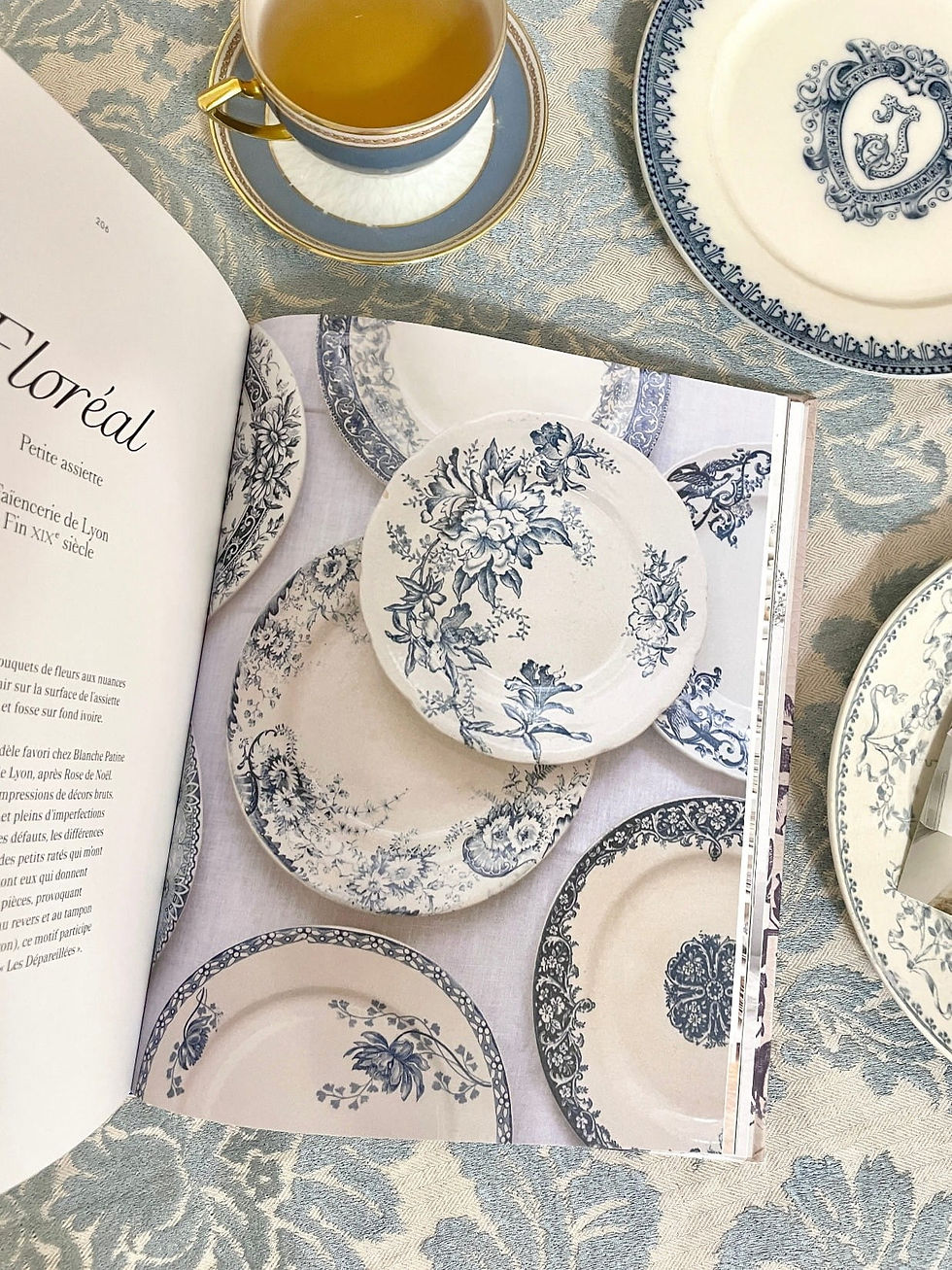
To help collectors and admirers better understand this world, Cécile has also published an elegant book about this subject, titled “Terre de fer: Collections de céramique française”. Published by Editions E/P/A in October 2024, with photographs by Karel Balas, this beautiful copy brings together key insights into the history, characteristics, manufacturing towns, and decorative meanings of French “Terre de Fer”, it also reflects Cécile’s broader commitment to preserving the spirit of French art de la table, and French savoir-faire through her extensive research, curation, and collecting.


Although it was only available in French, I had already purchased the book before visiting Paris, eager to deepen my understanding of this fascinating category. Despite my French not being that good, I was struck by its clarity, visual richness, and thoughtful structure even from the first few chapters. This book is not only informative, but also beautifully produced — the kind of volume that one can easily enjoy reading and get a better understanding of the world of French “Terre de Fer” with informative and harmonious interpretations, one would gladly leave on a coffee table or library shelf, ideally beside a cherished piece of “Terre de Fer”.

After all, we each collect the things we love for different reasons. If you are drawn to the quiet elegance of French “Terre de Fer” or faïence just like I do, I hope Cécile’s work and her showroom-gallery in Paris may offer you a new way to appreciate this overlooked world. Perhaps on your next visit to Paris, you too may discover a piece of beautiful history — one that carries within it the spirit of French craftsmanship, art de la table, and enduring charm. Something that is more meaningful and memorable than you can bring home apart from any souvenirs or luxury items that you can get from this fashion capital that is rich in French history and art de vivre.

